

Putting AI in it's place: How to use (and not use) AI in your creative practice
There's a lot of things you shouldn't let it do, but that doesn't mean it's all bad.

Welcome to Creative Constructs, a newsletter that shares systems, tools, and strategies for creative thinkers. (Here’s what Creative Constructs is all about.)

I have no illusions about whether I’m going to squash the whole “AI as savior” vs “AI as job thief” debate in a single post.
Half of us are (justifiably) excited about an AI-powered future where everything is easy and fast and cheap and automatic and convenient and…
The rest of us are (justifiably) worried about what AI’s widespread adoption will mean for art and creativity and employment and the environment and equality and…
The lists go on.
But I actually think the reality of our future is probably somewhere in between: Neither an AI-powered Utopia nor an AI-generated Dystopia, but just… well… an topia.
Or, a topos, technically, since the root of both potential outcomes is the Greek “topos,” meaning “place.”
Future aside, this place that we’re in, right now, is filled with AI tools that we can learn to use as responsibly and ethically as we can to do more of what we love, and perhaps make the future a place we’re a little less scared to be.
The way I see it, AI tools can absolutely have a place in a healthy creative practice,
as long as you’re mindful and intentional about what that place is.
Since AI and AI-enabled tools are often sold based on convenience, it’s easy to see what the instinct is often to use AI for any and all of the things you find inconvenient. We can see it in the ads, and pop-ups, and autosuggestions these tools put out:
Taking too long to hit your wordcount? Click here to generate another chapter!
Drawing a blank? Let the bot draw it for you!
Tap the star to turn your single title slide into an entire presentation!
The thing is, when you’re a creative, it’s often the unfun parts of the process that make the final product great. If you skip out on all the struggle and inconvenience—reflection, rearranging, revision—you miss out on the tension that makes the thing good to begin with.
The key to finding the right role for AI in your creative practice is not to get blinded by the idea of convenience, and to instead use AI as a substitute for the hard things
(Also, I’ve been lovingly using the em-dash since long before Generative AI was a twinkle in some billionaire VC partner’s eye, so I’ve decided I won’t be using it less just to convince you I’m not using AI to generate my copy. I’ll continue to rely on my unique voice, my intentional breaking of grammar and punctuation rules, and my unintentional typos for that.)

How You Can Use AI in Your Creative Practice:
To Avoid Distraction: If you find social media to be a distraction from your creative work, then by all means, lean into AI-powered tools to power your social channels.
✅ You can use it to help you extract social content from your larger works, batch-create first drafts of posts, schedule posts, and automate posting.
❌ I wouldn’t let it go around commenting as you, though. You need to think about how you feel about things and articulate those thoughts yourself.
To Identify Gaps: You are a human. (Love that about you, by the way). But being human does come with some built-in bugs, like privilege, limited experience, biases, and blind spots.
✅ AI can be a useful partner for reviewing your work to identify things you have missed, not considered, left out, ignored, glossed over, and more.
❌ I wouldn’t let it fix those gaps for you, though. You grow by reflecting on those gaps and devising ways to address them.
To Evaluate Ideas: When creativity is what fuels you, it’s easy to get excited about an idea and want to jump right to execution—See above, you lovely human person—but it can actually be helpful to have an unbiased thought partner to pressure-test ideas before you bring them to life.
✅ AI can help you weigh pros and cons, evaluate strengths and weaknesses, identify opportunities for improvement, uncover similar work, and otherwise dig into an idea’s merit before you get too far down the road.
❌ I wouldn’t let it generate your ideas, though. The only way to generate original ideas is to do that yourself.
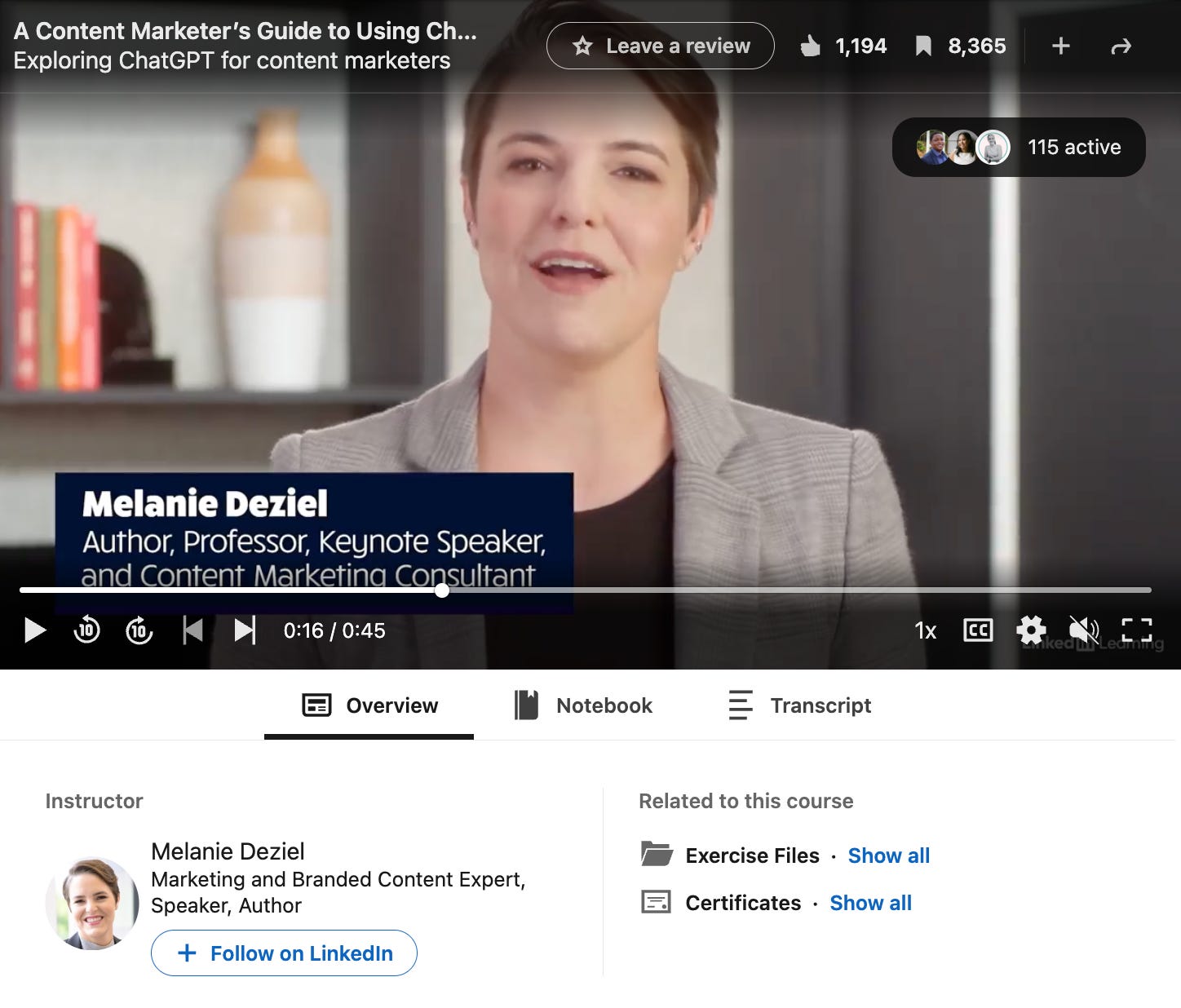
Fun fact: I actually have an entire course on LinkedIn Learning about how content marketers can use ChatGPT effectively without compromising their creativity, and the details inside would apply to most creatives, regardless of your job title.

Creative Sparks
“Why Don’t American Schools Teach Creativity?” by
via Catapult Magazine. The writer’s early experiences as a writer mirror my own, and I empathsize with the quiet quashing of creative dreams that often happens in schools. This is a great read.“Does zooming in help us zoom out?” by
. Shifts in perspective are always valuable as a creative, and this is an awesome refelction (and challenge, if you accept it) to notice the tiniest details.“Creativity can save the world,” by
. This piece is a nice reflection on the ways in which creativity, when leveraged by businesses, can actually change the world for the better. As an added bonus, there are a few mentions of AI in support of creativity (not as a substitute)n in this piece too.

More From Me:
As I mentioned above, check out my LinkedIn Learning course on how to use ChatGPT as a content creator and marketer. (I do make a small commission based on how many people watch it, so thanks in advance!)
I recently read “Make Your Art No Matter What: Moving Beyond Creative Hurdles,” by Beth Pickens and I really enjoyed it. If you’re dealing with any sort of imposter syndrome, this one might help you own the title of “artist” and “creative.”
I had a viral moment over on TikTok where I recently shared the miniature dioramas I make as a hobby for the very first time publicly. One of my videos has more than 150k view and 2500+ comments! Check it out.

The Creative Constructs newsletter is a labor of love supported by paid subscribers and occasional affiliate links, which offer me a small commission on sales of products I already love and would recommend anyway. Thank you for your ongoing support.